🇸🇪 Svenska · 🇬🇧 English · 🇪🇸 Español
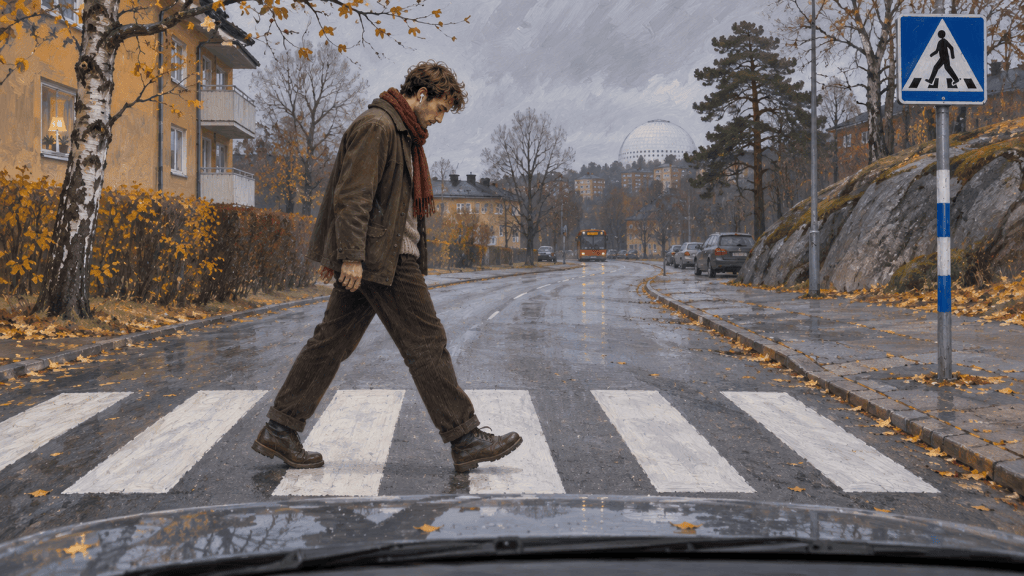
This morning, a young man walked across the road in front of me. He was looking down at the asphalt, a metre or so ahead of his feet. Not to the right. Not to the left. Just down.
The strange thing was that he did not even have a phone in his hand. It looked as though his head had become stuck in the position it takes when someone walks while staring at a screen. At first I thought: what kind of lunatic is that? Then I noticed the earphones. Perhaps he was listening to something and was mentally somewhere else entirely.
That was roughly where the thought arose: it is time to abolish Sweden’s Zebra Law.
We have forgotten to look both ways
Sometimes it feels as though an entire generation has forgotten what we once taught children: stop, look both ways and make sure it is safe before crossing. Now people walk straight out, often with their eyes on their phones and the world switched off through their earphones.
My encounter with the man this morning obviously proves nothing about an entire generation. But it captures a behaviour that bothers me: the conviction that someone else is responsible for safety.
The driver must stop. Therefore, I do not need to look.
That is a terrible principle on which to base one’s survival.
What happened to the accidents?
Sweden’s Zebra Law came into force on 1 May 2000. Its main purpose was to improve pedestrian mobility. According to VTI’s 2007 follow-up, report 597, pedestrians’ waiting times at unsignalised crossings fell by two thirds.
But VTI also estimated that the duty to give way increased the number of injured pedestrians at these crossings by 15–20 per cent and the number seriously injured by about 5–10 per cent. The assessment took account of factors including changes in accident reporting, increased traffic, and crossings being rebuilt or removed. Injury accidents in which a vehicle that had stopped for a pedestrian was hit from behind also increased; VTI estimated the rise at around 70 per cent.
At the same time, the full picture must be included. In the government’s reply to the Riksdag in December 2005, it was stated that deaths at unsignalised crossings had fallen from at least 15 a year before the reform to between five and ten a year in the preceding years.
More injuries and fewer deaths can therefore occur at the same time. Nor is a change after the law automatically an effect of the law: crossings and road environments were rebuilt during the same period. That was precisely why VTI tried to isolate the effect of the rule itself.
These are historical evaluations of the reform’s early years, not recent statistics on today’s mobile-phone habits. They show neither that earphones caused the accidents nor that abolishing the law today would certainly reduce them.
The right to cross does not replace the ability to think
Pedestrians already have responsibilities today. The Swedish Transport Agency states that pedestrians must take approaching vehicles into account before stepping onto an unsignalised crossing. The driver has a duty to give way, but pedestrians are therefore not allowed simply to step out without regard for traffic.
Even so, I think it is the first half of the message that has stuck. The driver must stop. Personal attention sometimes seems to have become an optional extra.
My conclusion is that the Zebra Law should be abolished and replaced with rules that more clearly require interaction before anyone steps into the road. Drivers should still slow down, show consideration and avoid putting pedestrians in danger. But anyone crossing the road must also make sure it can be done safely.
On heavily trafficked roads, we should provide safe crossings, low speed limits and traffic lights where needed. It is self-evident that people must be able to cross the road. That they should be able to do so while their attention is somewhere else entirely is a much poorer ambition.
You can have the right of way under the traffic rules and still end up in hospital. White stripes on asphalt do not repeal the laws of physics.
Abolish the Zebra Law. Teach us to look both ways again.
Image: AI-generated illustration.


Lämna ett svar