🇸🇪 Svenska · 🇬🇧 English · 🇪🇸 Español
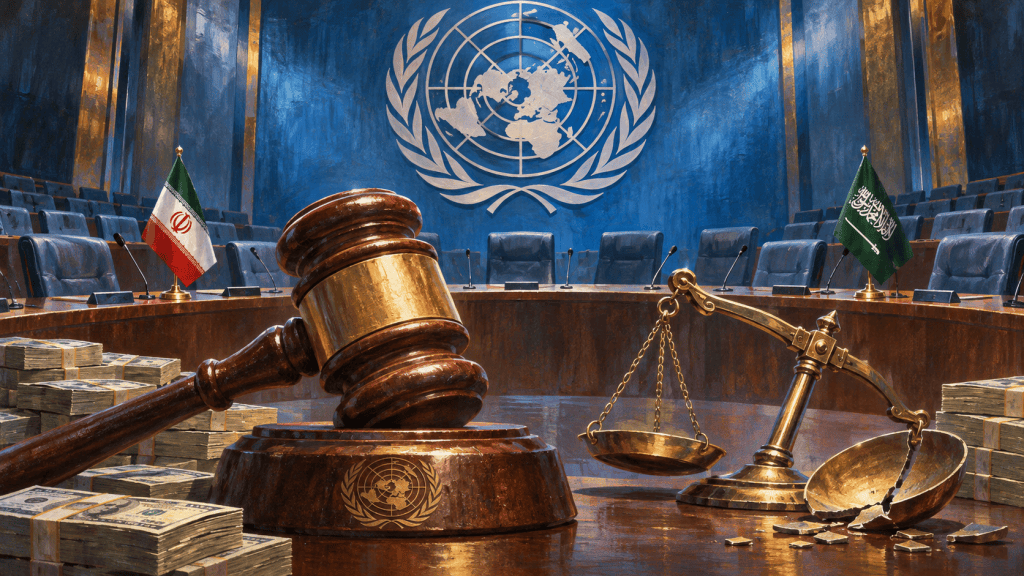
There are times when reality puts satire out of work. When a representative of Iran is allowed to chair a UN forum on human rights and Saudi Arabia is handed the gavel at the UN Commission on the Status of Women, we have crossed that line by a wide margin.
What comes next? North Korea as the international model for press freedom?
To be precise: Iran’s UN ambassador, Ali Bahreini, chaired the Human Rights Council’s Social Forum on 2–3 November 2023. That did not mean Iran chaired the entire Human Rights Council. Saudi ambassador Abdulaziz Alwasil, in turn, was chair of the 69th session of the UN Commission on the Status of Women in 2025. Two different roles, at different times. Both equally revealing.
Iran had moreover been removed from the Commission on the Status of Women following the regime’s repression of women and girls. That is stated in the UN’s own resolution. Yet the country’s ambassador was subsequently allowed to chair a forum under the Human Rights Council. One part of the organisation takes a stand against the repression. Another hands over the gavel.
And Saudi Arabia? Ahead of the appointment, Amnesty pointed to discriminatory family laws and the persecution of women’s rights defenders. Such a regime is therefore supposed to lead the work of a commission for women’s rights. It is like putting an arsonist in charge of the fire protection association.
I understand that international diplomacy means talking to regimes one despises. But why should they be allowed to chair the very bodies that deal with rights they themselves violate? A seat at the negotiating table and the chair’s gavel are two different things.
Regional rotation and diplomatic deals may explain how it happens. They do not make it any more reasonable. If the rules produce such outcomes, the rules are wrong.
Of course, there are people within the UN who do life-saving work. Food for the hungry and help for refugees are needed. But their work must not be used as an eternal free pass for the organisation’s political hypocrisy.
Total expenditure across the UN system amounted in 2024 to about 66 billion US dollars. At a rounded exchange rate of ten Swedish kronor to the dollar, that is roughly SEK 660 billion in a single year.
I am convinced that the money can be used better. Direct the resources to concrete assistance that reaches people and to forms of cooperation where human rights actually mean something. Every krona must be justifiable. The fact that the organisation also does good is no argument for continuing to finance political hypocrisy without imposing demands.
An organisation that claims to defend human rights must be able to distinguish between scrutinising oppressors and giving them prestigious assignments. Otherwise, the rights become a stage set and the UN logo a way to polish the regimes’ reputations.
Sweden should demand that leadership roles in human-rights work require respect for the rights concerned. If the UN cannot even clear that bar, we must build an international system of cooperation that can.
When the oppressors are handed the gavel, it is time to shut the damn thing down.
Image: AI-generated illustration.


Lämna ett svar