🇸🇪 Svenska · 🇬🇧 English · 🇪🇸 Español
Originally published in Swedish on 16 November 2026.
The Centre Party has chosen to continue negotiations with Magdalena Andersson. I still do not believe she will manage to form a government. The trenches between the Left Party and the Centre Party are too deep, and Sunday’s announcement does not fill them in.
On 15 November, the Centre Party announced that it wants to complete negotiations on Magdalena Andersson’s complete package. But the conditions remain: the Left Party must drop its demand to join the government, and both the Left Party and the Green Party must support the package. At the same time, the Left Party is standing by its demand for ministerial posts. That is where things stand.
The Centre Party may primarily be saving itself
My guess is that the Centre Party’s main reason for choosing Magda was to keep its own party together. According to the party leadership, both the executive board and the parliamentary group were united behind the decision. That does not rule out the possibility that party unity weighed heavily.
I have no insight into the internal discussions. But I imagine the decisive argument may have sounded something like this:
“What Magda has presented is so good that we cannot refuse to move forward without being accused of betrayal. Let us try that route. If she can keep what she has promised—above all, keeping the Left Party out of government—we go left. If she cannot, we can at least say that we tried everything before turning right. That way, we keep the party together.”
If so, the announcement also provides a possible route of retreat. The Centre Party gives Magda a chance to deliver while securing an argument for choosing Kristersson later: we tried, but the left could not agree.
Can the Left Party govern without sitting in government?
Magda’s plan is a government comprising the Social Democrats, the Centre Party and the Green Party, in close cooperation with the Left Party. The problem is that the Left Party wants ministerial posts while the Centre Party wants to keep it out.
Perhaps the remaining option is some form of coordination office where the Left Party gains insight, negotiating power and influence over policy without having ministers of its own. Formally, the party would still remain outside the government. Politically, it would try to sell the arrangement as participating in governing all the same. The Centre Party would say that the Left Party had been kept out.
Both parties could claim that they had kept their promises. Whether voters or Left Party members would buy the wordplay is another matter.
Another conceivable compromise would be for Nooshi Dadgostar to become minister for social affairs while the Left Party receives no other ministerial posts. I do not believe the Centre Party could accept even that. And I consider it out of the question that it would accept as many or more Left Party ministers than Centre Party ministers. Judged by the parties’ respective sizes, that would otherwise be a reasonable demand from the Left Party: the Left Party has 30 seats and the Centre Party has 25.
Then there is the Green Party. It is not merely decoration in the negotiating room. It, too, could throw a spanner in the works before everything is settled.
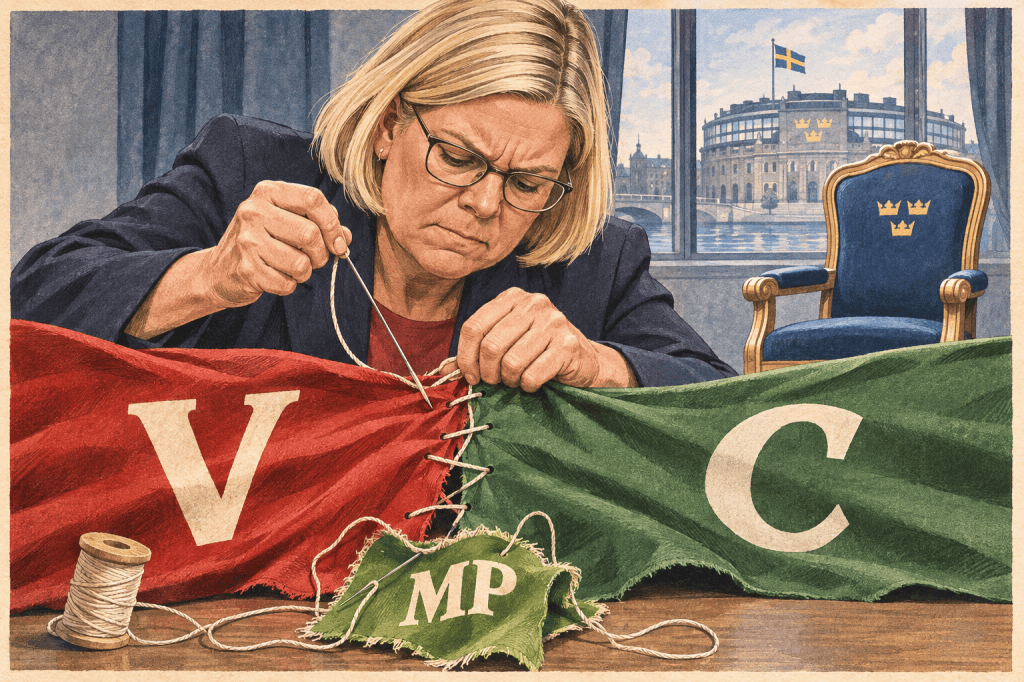
If Magda manages to stitch all this together, she is a better negotiator than I think. My guess remains that she will fail.
Three outcomes—and one resignation
I therefore stand by the prediction in “Magda Won the Election—and Lost Power”.
My main scenario is that Ulf Kristersson remains prime minister in a new government. The second alternative is an extraordinary election, after which I believe he will have the opportunity to form a majority government.
In both cases, I believe Magda will step down as Social Democratic leader within six months, no later than mid-May 2027. How voluntary that departure would be matters less to my assessment. I believe she will leave.
The third and, in my view, least likely alternative is that she actually succeeds in forming her government. In that case, I instead believe she will remain prime minister for at least three years. Anyone who has managed to negotiate a way through this tangle will have both strengthened her position and induced the cooperating parties to invest heavily in the arrangement.
The wild card is Andreas Norlén
Two candidates for prime minister have already been rejected: Magdalena Andersson on 15 October and Elisabeth Thand Ringqvist on 3 November. After four rejected proposals, an extraordinary election must be held. The order of the two remaining attempts may therefore prove decisive.
Kristersson is due to report on his exploratory mandate on 17 November. If Norlén then allows Parliament to vote on him and he loses, only one attempt will remain. If that attempt goes to Magda, her vote will be the last before an extraordinary election.
That could give her stronger negotiating leverage: reach an agreement now, or let the voters have their say again. I would also read it as a political signal that patience with the Centre Party on the right has run out. However neutral the Speaker is supposed to be, he is of course in contact with his party leader.
If Magda is put to a vote first and fails, and Kristersson then becomes the fourth proposal, the pressure will fall on the Centre Party. My guess is that it will come crawling back to the right rather than take responsibility for an extraordinary election.
If you cannot sleep with the person you want, you have to want the person you can get. The alternative is not sleeping with anyone at all.
Image: AI-generated satirical illustration.


Lämna ett svar