🇸🇪 Svenska · 🇬🇧 English · 🇪🇸 Español
After examining healthcare and the police, it is time to look at schools. Sweden’s school system has changed fundamentally since the school choice reform. But the interesting question is not how many options we have been given. It is how much more we pay—and how much better children actually learn.
50 percent more expensive per pupil—in real terms
In 1991, the year before the school choice reform, the average cost of compulsory school was SEK 51,500 per pupil. Adjusted using Statistics Sweden’s consumer price index, that equals about SEK 94,100 in 2024 prices. In 2024, the cost was around SEK 140,300 per pupil. That is an increase of roughly 50 percent in real terms. See the Swedish Parliament’s figures for 1991, Statistics Sweden’s CPI and the Swedish National Agency for Education’s 2024 cost data.
What have we received for the roughly SEK 46,000 extra per pupil and year?
More expensive schools—but weaker knowledge
This is where the truly important comparison comes in. Swedish eighth-graders scored 540 points in mathematics in 1995 in TIMSS. In the 2023 assessment, the result was 517 points. That is a decline of 23 points. Results have improved since the low point in 2011, but the 1995 level has still not been regained. See the Swedish National Agency for Education’s TIMSS 2023 report.
Reading has not improved either. Swedish fourth-graders scored 561 points in reading comprehension in 2001 and 544 points in 2021 in PIRLS. A government inquiry also shows that reading ability had already deteriorated between 1991 and 2001. See the Agency’s PIRLS report and SOU 2024:81.
In other words: roughly 50 percent higher spending per pupil in real terms, but worse results in both mathematics and reading in these long-running assessments. That is not evidence that the money has been used well. At the same time, schools have changed in more ways than through the school choice reform: municipalisation, new curricula, immigration and changing support needs have also affected the development.
Schools should hold the country together—not sort children
The old comprehensive school had another task that is easy to forget when everything is reduced to school vouchers and consumer choice. Children from different home circumstances, income levels and backgrounds met in the same classroom. They did not only learn history and mathematics. They learned to live with people who were not exactly like themselves.
When schools compete for pupils and families actively avoid certain schools, we risk creating parallel worlds as early as primary school. According to the Swedish National Agency for Education’s analysis of school segregation from 1998 to 2024, about one quarter of the increase in segregation is explained by school choice and three quarters by residential segregation. School choice is therefore not the whole explanation, but it has contributed.
I believe that is a powerful argument for a more cohesive school system. We need more meeting places for children from different backgrounds, not more institutions that separate them. A school system that holds children together helps hold Sweden together.
Two school systems funded by the same taxes
Independent schools can choose where to establish themselves and, on average, report a lower cost per pupil than municipal schools. Municipalities, however, must provide school places even where the number of pupils is shrinking. An empty seat in a municipal school still costs money when a pupil chooses an independent school. We must therefore count the cost of the entire system—not merely compare the budgets of two schools.
Research has found positive effects from competition by independent schools, including an IFAU study. That should not be hidden. But it does not relieve politicians of the duty to explain what parallel premises, administration and excess capacity cost today.
Diagnoses require support—not more paperwork
More children receive neurodevelopmental diagnoses and more support needs are identified. The National Board of Health and Welfare states that the share of 10–17-year-olds with an ADHD diagnosis continues to rise; in 2025, nearly 14 percent of boys and just over 9 percent of girls had such a diagnosis. This is a dramatic development that should prompt more questions: Have children’s difficulties increased just as quickly, or have we also changed what we diagnose and how we deal with it? See the Board’s latest statistics.
Under Sweden’s Education Act, pupils must receive support according to need without first requiring a diagnosis. Even so, government inquiries have noted that diagnoses or medical assessments are sometimes required in practice for additional resource allocation. That reveals a systemic failure: children risk going without help while their families chase certificates, schools fill in forms and healthcare is burdened with assessments.
School meals show a similar development. It is no longer only a matter of allergies and medically necessary special diets. Many kitchens also handle individually adapted meals for other needs. In one widely discussed example in Västerås, a kitchen reduced requested special meals from 80 portions to 20 after changing its working method and persuading more pupils to eat the regular food. See SVT’s report. It shows that the number of adaptations is not always fixed.
Special diets for allergies, for example, must work, and pupils with disabilities may need adaptations in order to eat at all. But it is reasonable to distinguish medical needs from mere food preferences. The Swedish Food Agency explains the difference between special diets and adapted meals. We need to know what all the special arrangements cost and why they are needed—otherwise taxpayers pay without anyone seeing the whole picture.
Immigration places different demands on teaching
Pupils who arrive in Sweden during their school years and do not yet speak Swedish need more educational support. Ignoring that would be as foolish as blaming all of the school system’s problems on immigration. Language, age at arrival and socioeconomic circumstances must be taken into account when schools are compared. But the requirement to actually learn to read, write and do arithmetic must not be lowered. This can hardly explain the entire cost increase, however, and we need to consider whether a 13-year-old who cannot read or write should be pressed into fifth or sixth grade, or whether a completely separate educational track would be better.
Who is accountable for the results?
When spending rises sharply, someone must be able to show where the money goes. To teachers and pupils? Or to premises, duplicate organisations, marketing, reporting and central administration?
My thesis is that the independent-school system has created costly duplicate capacity and weakened overall responsibility while administration has grown. It is the same question I asked in my examination of the police and my examination of healthcare: How much of the tax money goes to the actual mission, and how much disappears along the way? The school choice reform alone does not explain the long-term cost increase, but it has contributed. A school policy content to count choices instead of knowledge and kronor has missed its most important task.
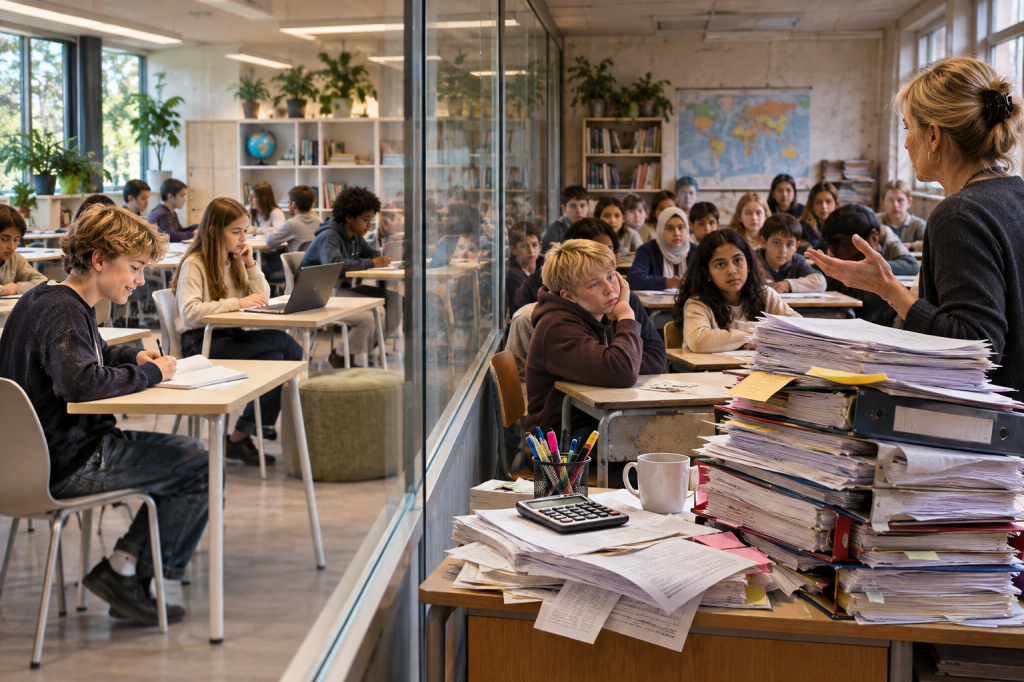
The image is AI-generated. Originally published in Swedish on 22 November 2026.


Lämna ett svar