🇸🇪 Svenska · 🇬🇧 English · 🇪🇸 Español
Let 16-year-olds earn a proper driving licence and drive a proper car. Limit their speed to 80 km/h until they turn 18 and impose requirements on safety equipment. That is a more sensible route than sending young people onto the roads in microcars or letting them create queues behind A-tractors.
Today, a 15-year-old may drive an A-tractor with an AM licence, but must wait until 18 to obtain a category B driving licence. An A-tractor may travel at 30 km/h. A microcar, which is normally classified as a class I moped, may travel at 45. I think we should rethink the system from the ground up.
A proper driving licence from 16
My proposal is a category B driving licence from the age of 16, with special conditions until the driver’s 18th birthday. The same requirements for theory, risk training and a practical driving test as for an ordinary car licence. Being young should not be a reason to avoid learning to drive properly.
The driver should be allowed to travel at no more than 80 km/h until turning 18. That need not mean a technical speed limiter in the car. I am open to such a solution, but let road-safety experts examine whether it is needed or whether a special speed rule for young drivers would be more appropriate. On roads with a lower speed limit, that limit naturally applies. Nor should the licence be a free pass for every vehicle and road: weight, engine power and which roads should be permitted must form part of the design.
An automatic transmission could be a condition during the first few years. A reversing camera could be another. I would also like to see requirements for electronic stability control, automatic emergency braking and documented good crash protection. A reversing camera helps when reversing, but replaces neither observation nor judgement.
Use the safety technology that already exists
Modern passenger cars have safety systems that older cars lacked. Folksam describes how driver-assistance systems can reduce accident risk. At the same time, the company points out that microcars provide poorer crash protection than passenger cars. A body that looks like a small car does not offer the same protection.
Why not use technological progress to give young people a better alternative? For someone who needs to get to school, training or work, a car can provide real freedom—especially where public transport is sparse.
Phase out today’s shortcuts
At the same time, I want to require a category B licence for A-tractors too—the vehicles colloquially called EPAs. That would remove the point of choosing a converted car to evade the requirements for driving a car.
I would prefer to ban microcars, at least in metropolitan regions once a better alternative exists. There, it is harder to justify both their weak crash protection and the traffic problems they cause. In rural areas, transport needs are different.
One alternative is to allow regions or municipalities to decide on such restrictions.
A queue behind you? Let it pass
If we retain today’s slow vehicles, the obligation to let other traffic pass needs to be clearer and enforced. A rule already exists: under Chapter 3, Section 38 of Sweden’s Road Traffic Ordinance, slow vehicles must, under certain traffic conditions, reduce speed and, when necessary, pull to the side as soon as possible to facilitate overtaking.
I want to go further: if a queue has formed behind the vehicle, the driver should use the next suitable and lawful opportunity to let it pass. That could be a lay-by or another safe exit, and a bus stop bay only where permitted and without obstructing bus traffic. No one should have to make a dangerous manoeuvre, but nor should a driver be able to pass opportunity after opportunity with a tail of cars behind.
The EU is moving in the right direction—but too slowly
A change is already on the way. The EU’s new Driving Licence Directive opens the door to category B1 from age 16, with theory and driving tests, for vehicles with a maximum authorised mass of 2,500 kilograms and a speed limit of 45 km/h. Most of the new rules will begin to apply in 2029.
My proposal remains a driving licence from age 16. If EU rules stand in the way, Sweden can start at 17, which is already permitted under the current Driving Licence Directive. But we should also demand an exemption allowing 16-year-olds to drive within Sweden’s borders. Current EU rules allow the age to be lowered to 17, but not 16. Those are the rules we should change, not the ambition. The EU should stay the hell out of what we do within Sweden’s borders. We should be able to decide for ourselves how young people drive on Swedish roads.
Give young people the opportunity to drive safer cars, require thorough training and reduce the number of road snails at the same time. Young people’s freedom and the flow of the rest of the traffic need not be opposites.
What do you think: would you rather meet—or find yourself behind—a well-trained 16-year-old in a safe passenger car with a permitted maximum speed of 80 km/h than today’s microcars and A-tractors?
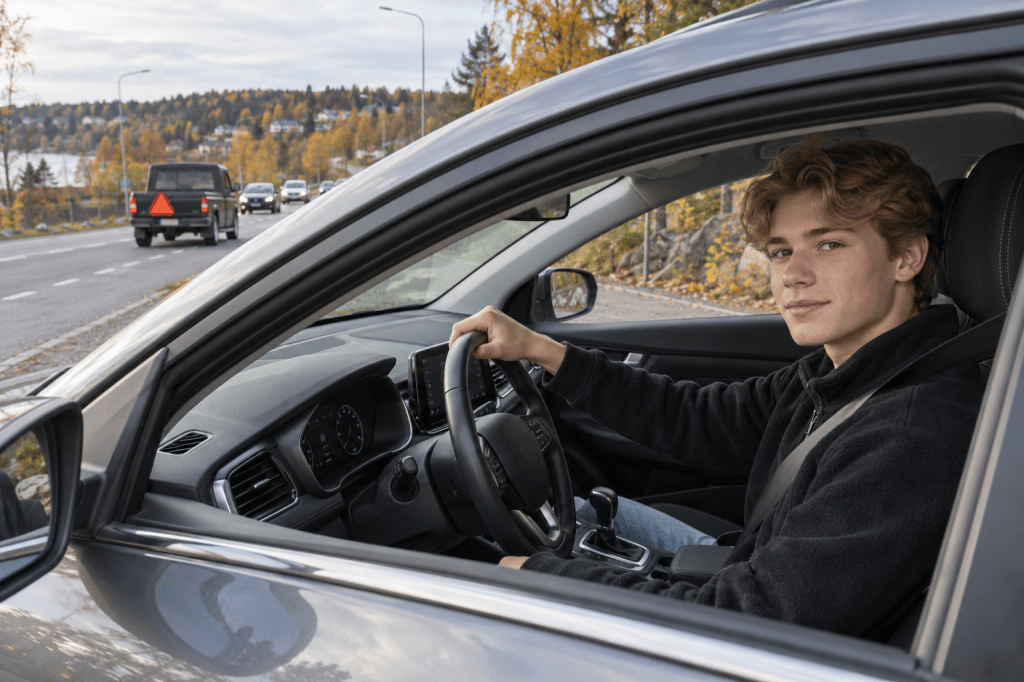
The image is AI-generated.


Lämna ett svar