🇸🇪 Svenska · 🇬🇧 English · 🇪🇸 Español
In disadvantaged areas, 25.6 per cent feel that voting differently from family and friends is not accepted. But in the rest of Sweden the figure is 14.8 per cent. That may represent far more people—and it deserves at least as much attention.
An article in Dagens Nyheter highlights a survey by Järvaveckan Research and Indikator Opinion. According to the survey, 25.6 per cent of respondents in disadvantaged areas believe it is not accepted to vote for a different party from family, relatives or friends. That is serious. Every voter must be free to think and vote independently.
But another figure stays with me: 14.8 per cent in the rest of Sweden report the same thing. That population is much larger. The number of people affected may therefore be considerably higher outside disadvantaged areas, despite the lower proportion. Exactly how many people are involved cannot be calculated without reliable population data and allowance for the survey’s uncertainty.
Where does the pressure come from?
We readily talk about social control in disadvantaged areas. But why do we so rarely discuss the social control that may exist in ordinary Swedish families, circles of friends and workplaces?
Part of the explanation may be the increasingly harsh polarisation. Social-media algorithms often reward conflict and strong reactions. We increasingly surround ourselves with people who agree with us, while the most inflammatory statements by our opponents are made to represent the entire other side.
But I do not think we can blame everything on the algorithms. Politicians also bear responsibility. When they reduce complex issues to slogans, demonise their opponents and portray the other side as a threat to democracy, the debate is dumbed down. If the election is described as a battle between good and evil, it suddenly becomes harder to tell family or friends that you intend to vote differently.
I suspect that someone considering voting for the Sweden Democrats feels the same kind of discomfort in certain social circles as someone considering the Left Party does in others. That is precisely why I would like to see more research into where the pressure comes from and the environments in which it occurs.
Social norms are not the same as coercion
We must also be precise here. The survey distinguishes between feeling that a different choice of party is not accepted and having personally been subjected to pressure. The latter is reported by 8.7 per cent in disadvantaged areas and 4.1 per cent in the rest of Sweden. None of this is in itself evidence of electoral fraud.
Even four per cent of a large population can represent a great many people. Should that not be discussed just as intensely?
Democracy requires more than free elections
Of course we should counter pressure in disadvantaged areas. But we must not allow a debate about the suburbs to obscure the same kind of problem in the rest of the country. The right to vote freely must also mean being able to think for yourself, change your mind and disagree with those around you without being regarded as a traitor.
And perhaps our politicians should start there: by ceasing to treat people who think differently as enemies.
Sources: Dagens Nyheter, 22 October 2026; Järvaveckan Research.
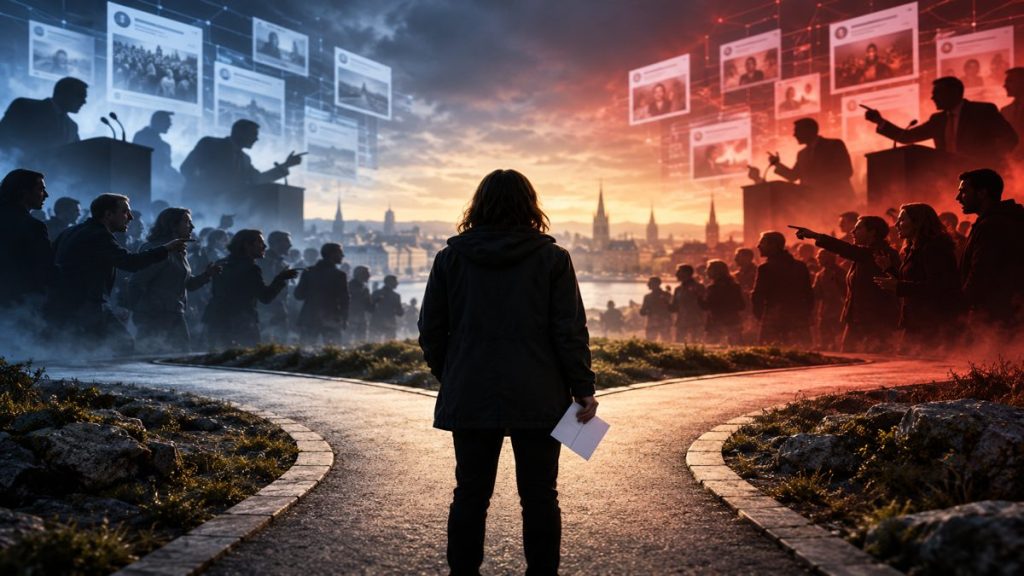
The illustration is AI-generated.


Lämna ett svar