🇸🇪 Svenska · 🇬🇧 English · 🇪🇸 Español
On 11 November, the Riksdag approved amendments to the Instrument of Government that will take effect on 1 January 2027. One of the most debated changes opens the way for legislation allowing Swedish citizenship to be revoked from dual citizens in certain cases. I wrote about that in Dual Citizenship Already Confers Special Status.
But when the constitution is being amended anyway, I am at least as interested in what is missing. Where is the broader protection of the individual’s right to be left alone?
Democracy gives us the opportunity to choose those who govern us. But why should that give the elected the right to decide every detail of our lives?
An election is not a blank cheque
I want to be able to vote on how we manage our common affairs without simultaneously surrendering authority over my body, my home and my relationships. Politicians, however, all too often seem to assume that everything that can be regulated should also be regulated.
Even when a child pedals along on a bicycle with training wheels, the legislature has decided that a helmet must be worn. The helmet requirement applies to children under 15 who ride bicycles. It may be excellent advice to parents. But not every piece of good advice needs to become law.
House colours also show that regulations can actually be rolled back. Following the easing of the rules in December 2025, the general rule is that detached and semi-detached houses may change colour without planning permission, although exceptions and other requirements remain. Good. That kind of returned decision-making power should be a principle, not something that depends on whichever government happens to be in office.
A constitution for the right to one’s own life
I would like to see a clearer constitutional charter of liberty. Whether it is framed as a new fundamental law or as a thorough strengthening of the Instrument of Government matters less than its substance. Here is my starting point:
- The right to choose one’s clothes. The state should not decide how adults dress. Specific requirements for protective equipment in dangerous work are one thing. Politicians prescribing how the population should look are another. Freedom must also protect anyone subjected to coercion by family members or religious representatives.
- The right to decide the terms of sexual relationships. Adults should be free to agree for themselves on their consensual relationships and what those relationships entail. Consent must be freely given and may be withdrawn. Politicians should not turn their own sexual morality into everyone’s law.
- The right to love whom one chooses. Consenting adults should be free to love one another, physically as well, regardless of gender or the opinions of those around them. Neither the state, the family nor a religious community should have a veto over their love lives.
- The right to think, hold opinions and believe freely. Even when an opinion is uncomfortable, a religion unpopular or a conclusion conflicts with the prevailing values. The same protection should apply to those who do not believe at all. Threats and concrete abuses can be prohibited without giving those in power the right to decide which views are acceptable.
- The right to one’s own body. The starting point should be that each person decides whether to take a vaccine, a medicine or a treatment. A doctor considering a decision unwise does not make the body the property of the state. Measures intended to protect others must be justified on their own merits and must not become a back door to unlimited compulsory treatment.
- The right not to be treated as a suspect. There should be no general licence to search, monitor or map people just in case. As a general rule, law-enforcement controls should be based on concrete, individual suspicion. Special security checks must have a clear and narrowly defined purpose. The entire population should not have to live as if it were the subject of an ongoing investigation.
- The right to pay cash over the counter. Ordinary purchases in physical shops should be possible with cash, without requiring a smartphone, banking app or a digital trail held by a payment provider. This also requires obligations for retailers and a functioning cash-handling system. A right that no one is obliged to enable is merely a fine phrase.
- The right to remain anonymous in public. Walking down the street should not require a person to identify themselves. Driving, crossing borders, withdrawing money and entering certain agreements can justify identification. Merely existing in public should not. Exceptions must be tied to a specific need, not to the authorities’ desire always to know who everyone is.
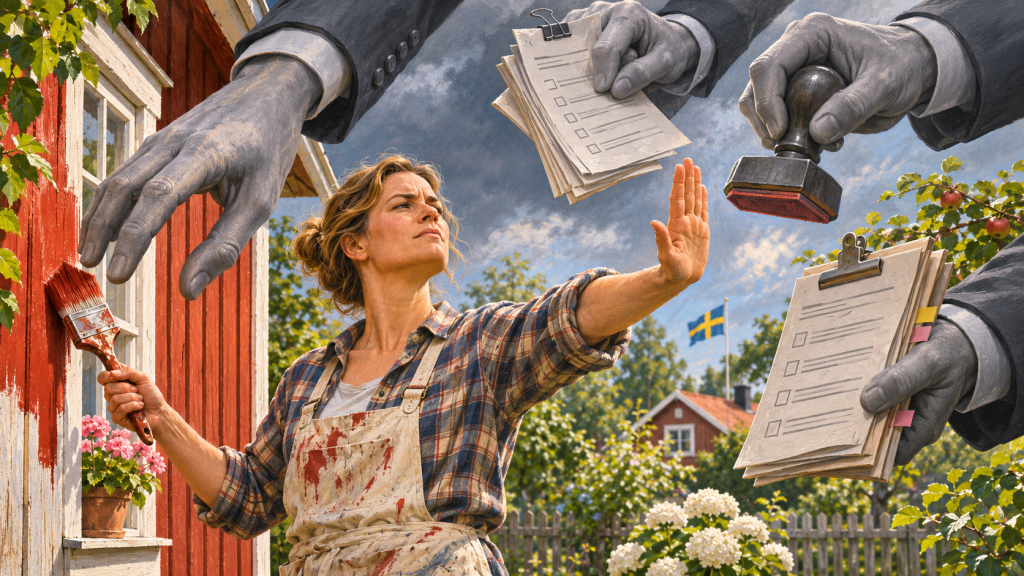
- The right to decide over one’s home and property. As a starting point, I should be free to paint my house whatever colour I choose. Restrictions on how I use, alter or extend my property should require concrete reasons. Fire safety, significant harm to neighbours and especially valuable cultural environments must be manageable. A civil servant preferring another colour should not be enough.
- The right to move freely. We should be able to be in public places without buying anything, identifying ourselves or explaining our purpose. Restrictions should concern concrete risks, obstructions or infringements of other people’s rights. Someone disliking our presence, clothing or views is not such harm.
Freedom must be defensible against those in power
Several of these freedoms are already protected by Chapter 2 of the Instrument of Government. It includes freedoms of opinion, protection against forced bodily interventions and invasions of privacy, and protection of property. It also sets out how several rights may be restricted. We are therefore not starting from zero.
But I want the main rule to be clearer: Anyone who wants to restrict a person’s freedom must prove why it is necessary.
There should have to be a concrete harm or risk to the rights of others, evidence that the measure works and an assessment of less intrusive alternatives. The possibility that people may make the wrong choice is not in itself a sufficient reason. Nor is the possibility that taxpayers may sometimes have to bear a cost. Otherwise, almost every part of life can soon be turned into a public matter.
There must also be an explicit right to make decisions that others consider foolish. Freedom that applies only when people choose what politicians recommend is not worth much.
The individual must be able to have an intervention reviewed quickly by an independent court and obtain real redress when the state goes too far. Sweden already has judicial review of legislation. I want to strengthen the ability to use it and make it financially possible for an ordinary person to defend their rights.
Laws that restrict freedom should also be reviewed after a set period. Temporary emergency measures should expire unless they are expressly renewed and justified. “It was once necessary” must not become a permanent argument.
The scope of politics must have a boundary
The difficult part is drawing the boundary around our common affairs. Air, water, the spread of infection and neighbours’ safety can affect more people than the person making the decision. Shared rules are needed there. But the connection must be concrete. If anything that affects someone else in any way gives politicians the right to decide, no private sphere remains.
I see political meddling as an international problem. That is why I also want stronger protection for the individual in European cooperation and in international human-rights agreements. A Swedish constitutional amendment alone will not solve what foreign states or global platforms do. But that is no argument for declining to limit the power we actually can limit.
Politicians should manage our common affairs. They should also be able to explain why an issue belongs there in the first place.
We need a constitution that makes it harder to control us simply because it is possible.
Which freedom would you protect first—and where would you draw the boundary of political power?
Image: AI-generated illustration.


Lämna ett svar