🇸🇪 Svenska · 🇬🇧 English · 🇪🇸 Español
The Swedish Enforcement Authority should not deal with small debts. Set a threshold of, say, SEK 5,000 in total overdue debts per person. Make the credit companies bear more of the risk themselves.
With Expressen’s headline about Klarna’s new requirements in mind, I wonder whether politicians are starting at the wrong end. A new Consumer Credit Act takes effect on 20 November 2026. According to the Swedish Consumer Agency, credit assessments will be tightened even for small loans and buy-now-pay-later services.
I would rather change the rules of debt collection than micromanage which information companies must collect about us. Anyone who makes money by extending credit must also take responsibility for whether the customer can repay it.
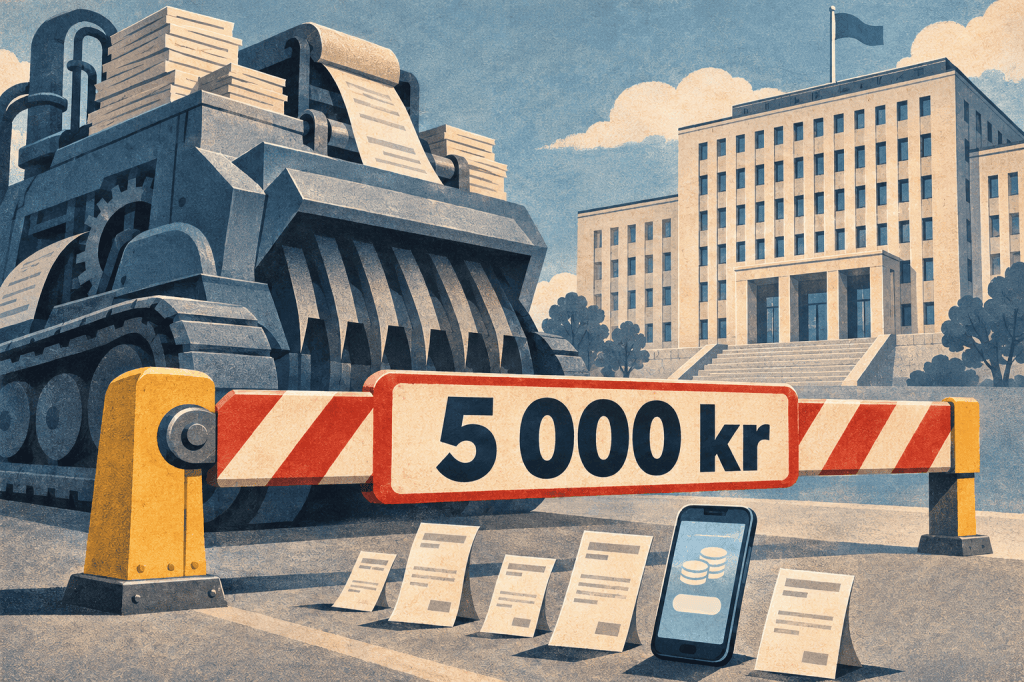
SEK 5,000 in total
My proposal is simple in principle: if a person’s total overdue debts are below SEK 5,000, the Swedish Enforcement Authority should neither process the payment claims nor collect them. The threshold should apply per person, across all creditors.
A single disputed parking charge or a disagreement over a minor purchase could then not simply be sent on to the Enforcement Authority. The company would have to sort it out with the customer and, if necessary, have the dispute adjudicated. The state’s debt-collection machinery should not be the first convenient means of pressure.
Someone who systematically refuses to pay, however, will soon exceed the threshold. Ten unpaid claims of SEK 600 amount to SEK 6,000 together. The Enforcement Authority could then take up the matter even though no individual claim reaches SEK 5,000.
Make payday lenders bear the risk
Such a threshold would make it harder to collect small payday loans with the state’s help. That is part of the point. If the lender knows that the Enforcement Authority is not immediately available, the company must be more careful about whom it lends to.
In my assessment, that could lead some companies to reject more risky loans. It could also make small loans more expensive or less accessible. But why should the state make it easier to sell quick loans by standing ready to collect every tiny amount?
A small debt should not become an administrative merry-go-round
It is already possible to contest an incorrect claim with the Swedish Enforcement Authority. If the creditor wants to proceed, the dispute can be referred to court. My proposal goes further: small claims should be kept out of the Authority’s process altogether until the total threshold has been reached.
That is why merely stopping the seizure of assets is not enough. The threshold must also cover orders to pay. Otherwise the same means of pressure remains. Nor should companies be able to pile on fees in order to cross the threshold artificially.
This requires legislative changes and a functioning way to aggregate valid, overdue debts from different creditors. A disputed assertion of a debt should not automatically count as an established debt. The details need to be resolved, but the principle is reasonable.
The obligation to pay should remain. Creditors should still be able to demand payment and have their rights adjudicated. But access to the state’s collection machinery needs a lower limit.
Politicians should spend less effort deciding how credit companies design their forms and more on making them bear the consequences of their lending decisions. The Swedish Enforcement Authority should not serve as the payday lenders’ extended arm for small change.
Image: AI-generated illustration.


Lämna ett svar