🇸🇪 Svenska · 🇬🇧 English · 🇪🇸 Español
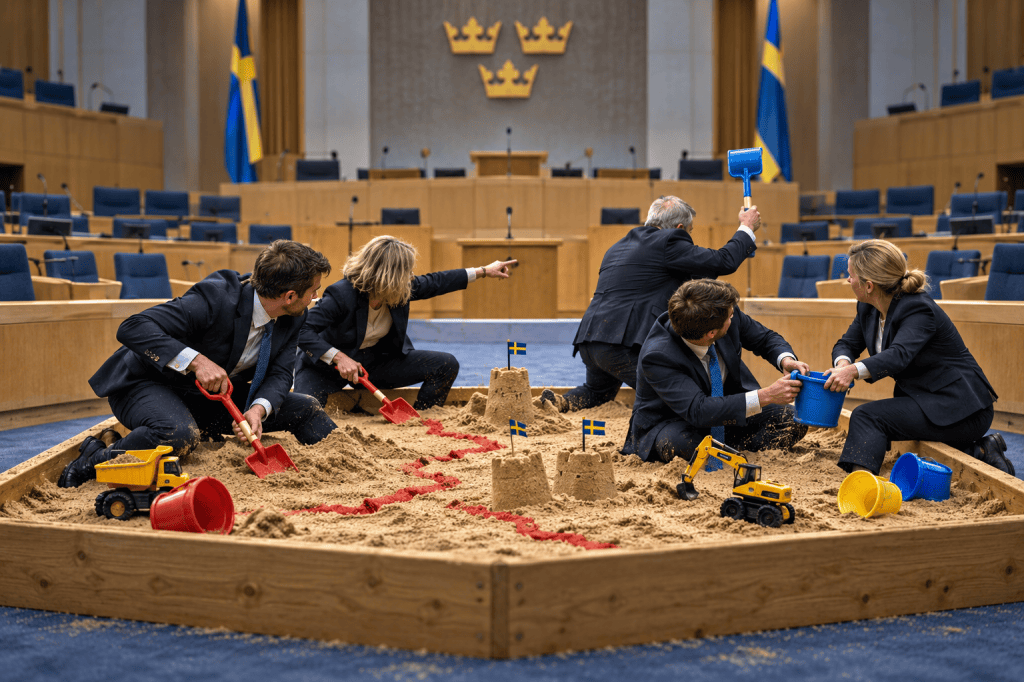
It should not be so difficult to form a government in Sweden. But when parties draw their red lines around whom they are allowed to talk to rather than what policies they are prepared to pursue, government formation becomes a game in the sandbox.
After the election, the Social Democrats, the Centre Party, the Left Party and the Green Party hold 176 seats between them. But counting seats is not enough if they cannot agree on how power should be used. The Left Party wants a place in government, while the Centre Party rejects precisely that. There is more discussion about who is allowed to join than about what voters should actually gain from the cooperation.
Draw red lines around policy
Imagine if the parties said instead:
- “We will not join a government that fails to solve the problem of teenage deportations.”
- “We will not join a government that fails to invest in new nuclear power, for example at Barsebäck.”
- “We will not join a government that fails to abolish the qualifying-day deduction for sick pay.”
Barsebäck is, of course, no random allusion. Before the 1976 election, Thorbjörn Fälldin promised that he would not participate in loading any new reactor and declared that no cabinet post was worth “compromising my convictions”. Yet Barsebäck 2 was loaded once he had become prime minister. It was a red line on substantive policy, but also a reminder of what happens when absolute promises meet the responsibility of governing. It would be slightly ironic if today’s politicians could learn something from Fälldin: stand by your policy positions, but recognise that government requires negotiation. SVT has retold the story of Fälldin and Barsebäck. The Centre Party, at least, ought to know it. Sometimes you have to compromise if you want to be in the room with the adults.
I am not saying that all these proposals are right. The point is that they can be negotiated, costed, tested and ultimately put to a vote. A categorical “we will never sit in the same government as them” cannot.
Teenage deportations also show why policy issues are better than symbols: the government has already presented proposals for a special solution for certain young adults. The relevant question is therefore whether that solution is sufficient, not which party’s name appears on the proposal. There is also a concrete application for state support for a new nuclear-power project at Barsebäck. And the qualifying-day deduction is a real issue of conflict between parties that need to be able to discuss costs and consequences.
Politics means prioritising—and compromising
Trust and values naturally matter. Nobody should have to abandon their convictions merely to obtain cabinet posts. But in a parliamentary system with eight parties, compromises are not a failure. They are a prerequisite.
A government must be able to function, not merely be appointed. But the path there should begin with a list of what the parties want to accomplish over four years, what they absolutely cannot accept and what they are willing to give up in order to achieve results.
If the focus had been on the substance of policy rather than on who is allowed to play with whom, I am convinced that Sweden would already have had a government.
There are no adults in the chamber.
Further reading
- Sveriges Radio: Red lines after the election
- Fokus: Four parties, three red lines and one prime minister
- The Swedish Government: Proposals for young adults
- The Swedish Government: Nuclear-power project at Barsebäck
- SVT: Substantive policy divisions in the government negotiations
This translation was prepared with AI assistance from the author’s Swedish article. The original was developed with AI assistance, and its featured illustration is AI-generated.


Lämna en kommentar