🇸🇪 Svenska · 🇬🇧 English · 🇪🇸 Español

Dagens Industri has published an opinion piece entitled “Let self-driving cars through”. On the surface it is about cars. But the bigger question is what role Sweden wants to play as the next generation of technology is developed.
Do we want to be a country where new technology is developed, tested and adopted early, or one that waits until someone else has done the work?
Sweden used to be very good at the former.
When Kista was Sweden’s Silicon Valley
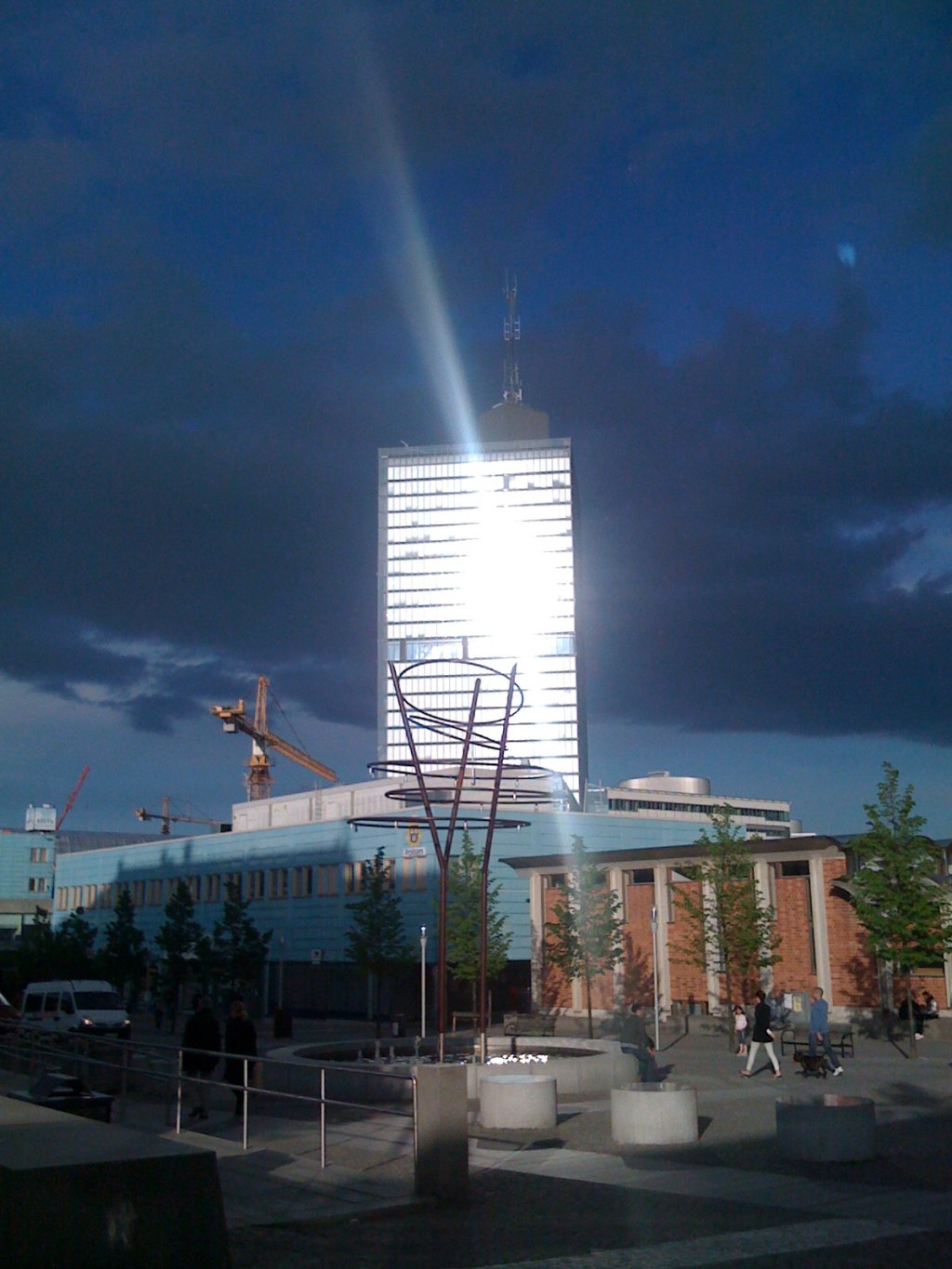
It is easy to forget what Kista once represented. One of Europe’s most important telecom and technology clusters grew here around Ericsson and many other companies, engineers and research communities. Kista was even called Europe’s, or Sweden’s, Silicon Valley.
It was more than a collection of office buildings. It was an ecosystem where technology could be developed, tested, improved and commercialised. Kista became associated with the future.
Now the movement is in the other direction. Ericsson has decided to move its Stockholm operations, including its headquarters, from Kista to Hagastaden. The relocation is due to begin in 2028 and continue for several years. That does not, of course, mean Swedish technological development will stop, but the symbolism is hard to ignore.
An area that once represented Sweden’s technological future is losing its most iconic tenant while the next major technological shift is already under way.
Self-driving cars are AI on wheels
Self-driving cars should not be seen solely as a matter for the automotive industry. They combine AI, sensors, cameras, communications, mapping data, software and advanced data processing.
That makes the field a meeting point for several technologies likely to shape the coming decades. That is why where the technology is allowed to be used matters.
Those who get to test real systems also gain data, engineering expertise, experience and companies that build services around the technology. Those who wait can, of course, buy it later. But that is not the same as helping to create it.
Bureaucracy is not the same as safety
The obvious objection is safety, and it must be taken seriously. A self-driving car among people is not a new app that can be launched and patched afterwards if something goes wrong.
But a distinction often gets lost here:
Regulation and safety are not the same thing.
Good regulation can improve safety. Poor regulation can instead add administration, costs and delays without removing a corresponding risk.
In Sweden, trials of automated vehicles on public roads currently require a special permit. Applicants must show that the trial can be conducted safely in traffic and that the risks have been addressed. From 2026, there is also an application fee of SEK 20,000, plus ongoing fees. The Swedish Transport Agency describes the requirements here.
Such requirements may be entirely reasonable. The key question is whether each rule can actually be justified by the risk it reduces.
That is a better principle than assuming that more permits, longer processes and more documentation automatically mean greater safety.
There is also a risk in waiting
Technology regulation is often discussed as though the choice were between regulation and safety on one side and rapid development and risk on the other. Reality is more complicated.
Today’s road system has risks too. People get tired, distracted and make mistakes. So the relevant question must eventually be how an automated system actually performs compared with a human driver under equivalent conditions, rather than whether the technology is perfect.
At the same time, these systems need rigorous scrutiny. The Swedish Transport Agency notes that EU rules for automated driving are now developing rapidly and that regulations are likely to make it possible to type-approve unlimited series of vehicles without a human driver in Europe from 1 January 2027. That work is described here.
This is not technology from the distant future. It is already on the doorstep.
Sweden cannot live on past technology victories
Sweden has an unusual record for such a small country. We have created and built companies such as Ericsson and Spotify and been early movers in telecoms, digitalisation and the internet economy.
But past success does not guarantee future success.
Kista is a good reminder. In the 1980s and 1990s, Sweden could be at the forefront of technology that later changed the world. Today, Ericsson has decided to move its Stockholm operations from Kista to Hagastaden starting in 2028. Ericsson describes the move here.
The point is therefore more than nostalgia for the days when Kista was called Europe’s Silicon Valley.
The question is: Where will the next Kista be built?
And perhaps more importantly: Are we giving those who want to build it the chance to do so here?
Caution has a cost too
A modern technological society needs both innovation and rules. But regulation should have a clear purpose: addressing identifiable risks.
When administration starts to be treated as a value in itself, caution can carry a cost rarely visible in the documents on which decisions are based:
- The company that is never established.
- The engineer who moves away.
- The investment that goes elsewhere.
- The technology developed in the US or Asia instead of Stockholm.
None of these events makes a dramatic headline on the day it happens. But over twenty years they can be the difference between a country that develops the next generation of technology and one that imports it.
Self-driving cars are therefore just one example. The bigger question is what kind of environment for innovation Sweden wants as AI, robotics and automation move from computer screens into the physical world.
Kista shows that Sweden was once at the centre of such a technological shift.
That is a history worth remembering when the next shift is already at the door.
This translation was produced with AI assistance from the author’s Swedish article. The original text was drafted with AI assistance. The photograph is credited above and is not AI-generated.


Lämna en kommentar